Choosing the right heating method is one of the most important decisions when purchasing an industrial popcorn machine.
For commercial popcorn production, two heating technologies are commonly considered: gas heating and electric induction heating.
Both can be used for high-capacity popcorn production, but they are designed for different operating conditions. The right choice depends on your required output, available utilities, factory infrastructure, operating environment, automation requirements, and future production plans.
So, which is better: a gas popcorn machine or an electric induction popcorn machine?
There is no single answer for every business.
A gas-heated popcorn machine can be a practical choice where electricity capacity is limited or LPG is readily available. An electric induction popcorn machine can be more suitable for manufacturers looking for higher production capacity, responsive heating control, and an electrically powered production system.
This guide compares the two heating methods to help popcorn manufacturers, snack factories, food processors, cinemas, amusement parks, and commercial food businesses make a more informed equipment decision.
Gas vs Electric Induction Popcorn Machine at a Glance
Before looking at the details, here is a quick comparison:
| Feature | Gas Popcorn Machine | Electric Induction Popcorn Machine |
| Heating method | LPG / gas heating | Electromagnetic induction heating |
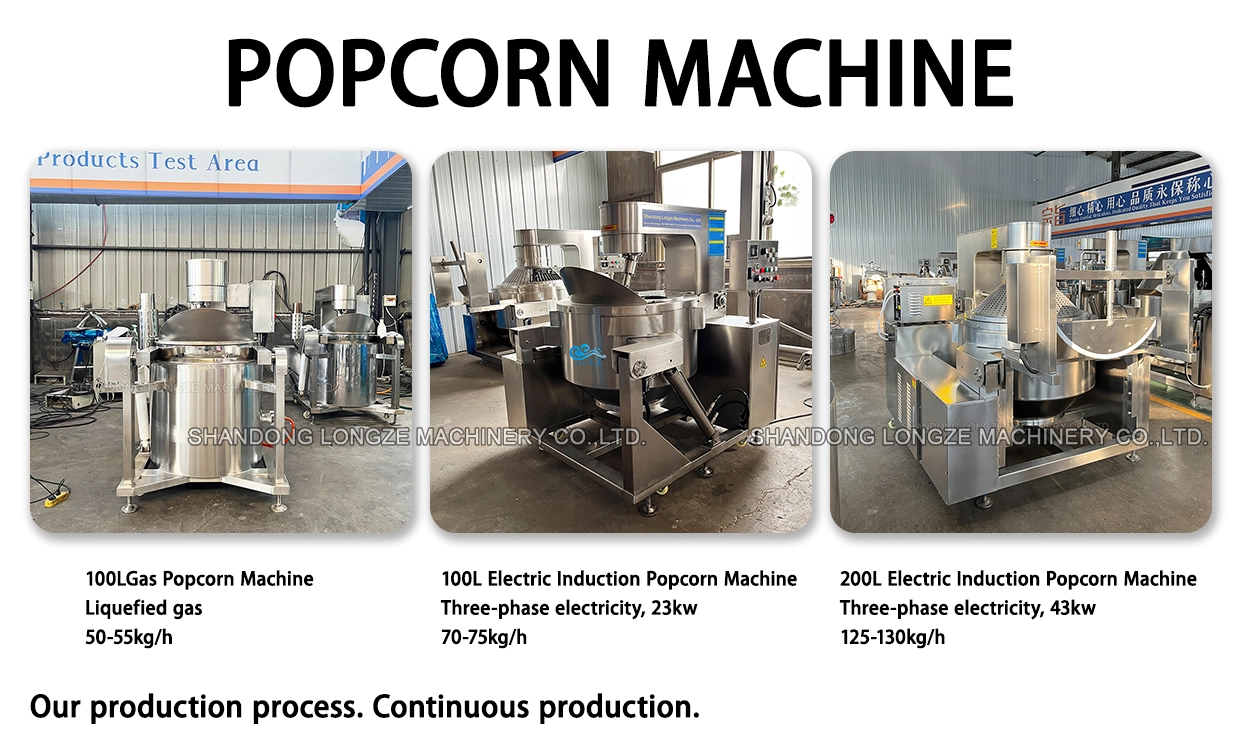
| Typical Longze configuration | 100L | 100L/200L |
| Approx. output | Up to about 55 kg/h | About 75–130 kg/h |
| Heating control | LPG | 8-level power adjustment, three-phase power supply |
| Suitable for | Medium production and areas with reliable gas supply | Medium to high-volume production |
| Automation options | Available | More advanced control options available |
| Expansion | Can be integrated into production lines | Can be integrated into production lines |
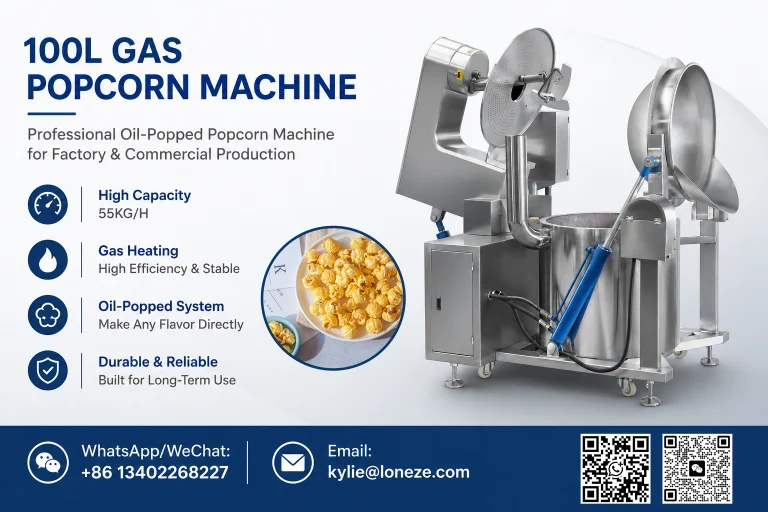
For Longze’s current industrial popcorn machine configurations, the 100L gas-heated model is designed for approximately 55 kg/h, while the 100L electric induction model is approximately 75 kg/h and the 200L electric induction model approximately 130 kg/h.
Actual production capacity depends on the popcorn recipe, raw materials, batch size, operating conditions, and production process.
1. How Does a Gas Popcorn Machine Work?
A gas popcorn machine uses LPG or another suitable gas supply to generate heat for the cooking pot.
The heating system transfers thermal energy to the cooking vessel while the mixing system continuously agitates the ingredients during the popping process.
For commercial applications, gas heating can be attractive because the equipment does not require a large electrical heating system.
A gas popcorn machine may be particularly practical when:
- LPG is readily available
- The factory has limited electrical capacity
- Gas energy is more convenient in the local market
- The production site already uses gas-powered food processing equipment
- The required production volume is moderate
- The customer prefers a conventional gas heating system
For example, Longze’s 100L gas popcorn machine is designed for approximately 55 kg of popcorn per hour under specified production conditions.
Advantages of Gas Heating
1.1 Suitable for areas with limited electrical capacity
One of the biggest advantages of a gas popcorn machine is that the main heating energy comes from LPG rather than a high-power electrical heating system.
This can be important for factories where the available electrical infrastructure cannot support a large induction heating system.
1.2 Familiar heating technology
Many food-processing facilities already operate gas-heated equipment. For these customers, integrating another gas-heated machine into the production area may be straightforward.
1.3 Flexible for certain factory environments
If LPG is easily sourced and electricity is less reliable or more expensive to expand, gas heating can be a practical option.
2. How Does an Electric Induction Popcorn Machine Work?
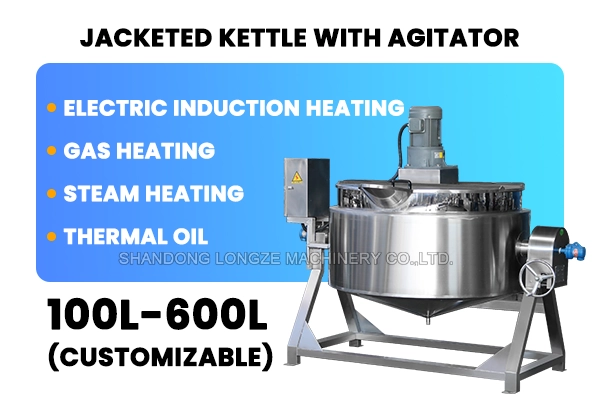
An electric induction popcorn machine uses electromagnetic induction heating instead of a direct gas flame.
Electrical energy is converted into electromagnetic energy to generate heat in the heating system. This provides an electrically powered heating method that can be controlled through different power levels.
One of the important features of Longze’s electric induction popcorn machine is its 8-level power adjustment.
Operators can select different heating power levels according to the production stage and recipe requirements. This makes it possible to adjust the heating intensity more precisely during the popcorn-making process and helps achieve more consistent temperature control.
For industrial popcorn production, electric induction heating can be particularly useful when the factory has sufficient electrical capacity and requires higher production output or more adjustable heating control.
Longze currently offers 100L and 200L electric induction popcorn machine configurations. The 100L model is designed for approximately 75 kg/h, while the 200L model can reach approximately 130 kg/h under specified production conditions.
Advantages of Electric Induction Heating
1.1 Higher production capacity options
One important difference between the available configurations is production capacity.
For Longze’s popcorn equipment:
·100L electric induction heating: approximately 75 kg/h
·200L electric induction heating: approximately 130 kg/h
This gives manufacturers more options when moving from medium-scale production toward higher-volume popcorn processing.
1.2 Induction Heating Control
Induction heating technology supports 8-level adjustment of the heating system.
This control method is particularly suitable when production processes require repeatable heating conditions or when operators need to adjust heating parameters based on different process recipes.
1.3 Suitable for high-volume production
For customers producing large quantities of popcorn every day, electric induction heating provides access to higher-capacity machine configurations.
The 200L electric induction model, for example, is designed for approximately 130 kg/h and is suitable for larger-scale popcorn production.
3. Gas vs Electric Induction: Which Has Higher Output?
Production capacity is one of the first factors commercial buyers should consider.
A machine should not be selected simply according to its nominal volume. The actual production requirement should be calculated in terms of kilograms per hour.
For example, if your factory needs approximately 40–50 kg/h, a 100L gas-heated popcorn machine may already provide sufficient capacity.
If your target is approximately 70–80 kg/h, a 100L electric induction machine may be more appropriate.
For production around 120–130 kg/h, a 200L electric induction machine provides a higher-capacity configuration.
This is why the question should not simply be:
“Is gas or induction better?”
Instead, ask:
“What production capacity does my business actually need?”
Choosing a machine that is significantly larger than your actual requirement can increase equipment investment and utility requirements. Choosing a machine that is too small can create production bottlenecks.
4. Which Heating Method Is Better for Energy and Operating Costs?
Energy cost is more complicated than simply comparing the price of electricity with the price of gas.
The actual operating cost depends on:
- Local electricity prices
- LPG prices
- Available electrical capacity
- Gas supply infrastructure
- Production hours per day
- Production volume
- Heating efficiency
- Local utility regulations
- Maintenance requirements
For this reason, it is not accurate to say that gas or induction will always be cheaper in every country.
For example, a factory located in an area with readily available and competitively priced LPG may find gas heating convenient.
Another factory with reliable three-phase electricity and a large daily production requirement may prefer electric induction heating.
A Better Way to Calculate Operating Cost
Before purchasing an industrial popcorn machine, compare the expected cost based on your actual production.
Consider:
Daily popcorn production × operating hours × local energy cost
Then compare the expected energy consumption of the available machine configurations.
For international customers, this calculation should be based on local utility prices rather than a general online estimate.
5. Which Is Easier to Control?
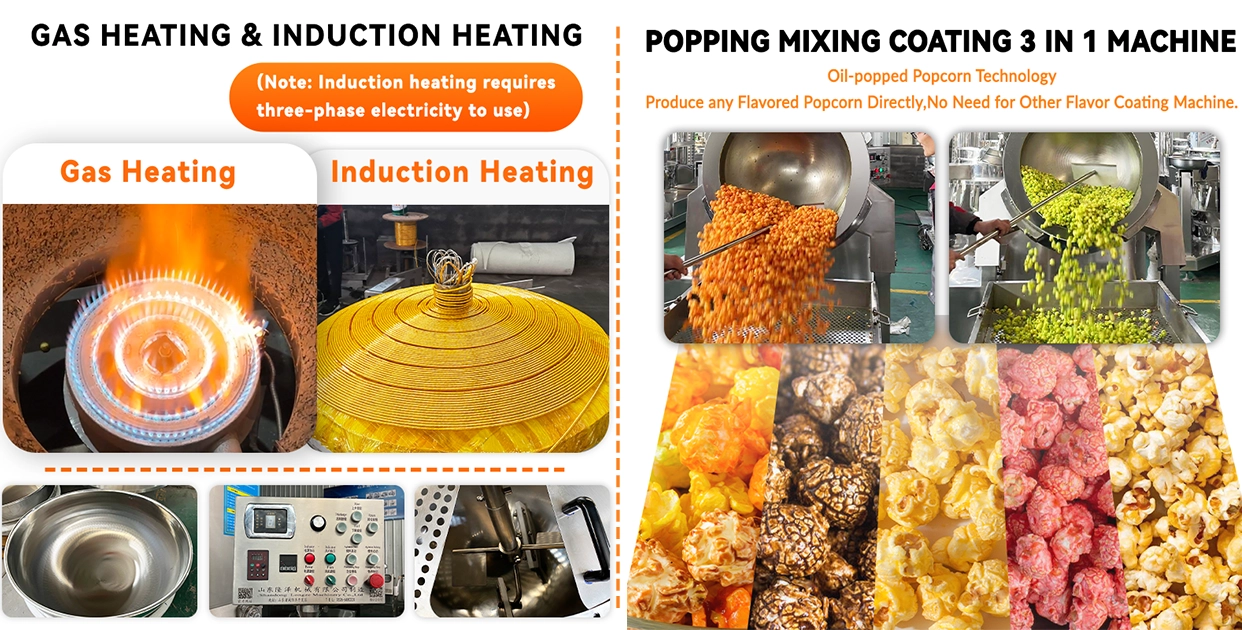
The electric induction heating system supports 8 levels of power adjustment, a feature that is highly advantageous when constant process conditions need to be maintained.
For commercial popcorn manufacturing, repeatability matters because the production process may need to handle:
- Different popcorn kernels
- Different oil ratios
- Different sugar or syrup recipes
- Caramel popcorn
- Sweet popcorn
- Chocolate-flavored popcorn
- Brown sugar popcorn
- Other customized flavors
Longze’s industrial popcorn machines use an oil-popping process that allows different flavored popcorn products to be produced directly in the machine without requiring a separate flavor-coating machine.
This means the heating system is only one part of the production solution. The recipe, ingredient ratio, stirring speed, heating conditions, and production process all influence the final product.
6. Don’t Forget the Popcorn Production Process
Choosing between gas and electric induction heating is only one part of planning an industrial popcorn production system.
For commercial popcorn manufacturing, Longze offers two main production line configurations:
- Standard Popcorn Production Line – Manual Machine Operation
- Unmanned Automatic Popcorn Production Line – Automatic Ingredient Feeding
The main difference is how the popcorn machine is supplied with ingredients and operated.
Standard Popcorn Production Line
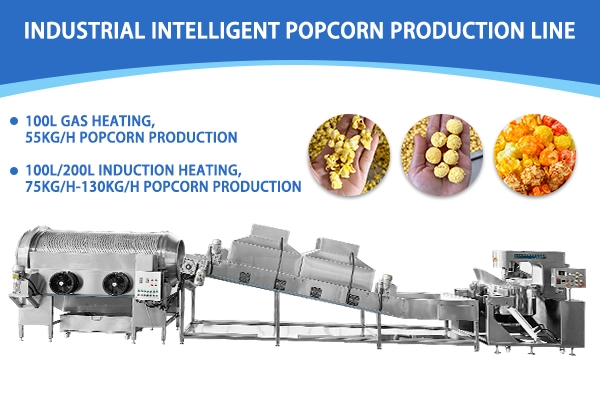
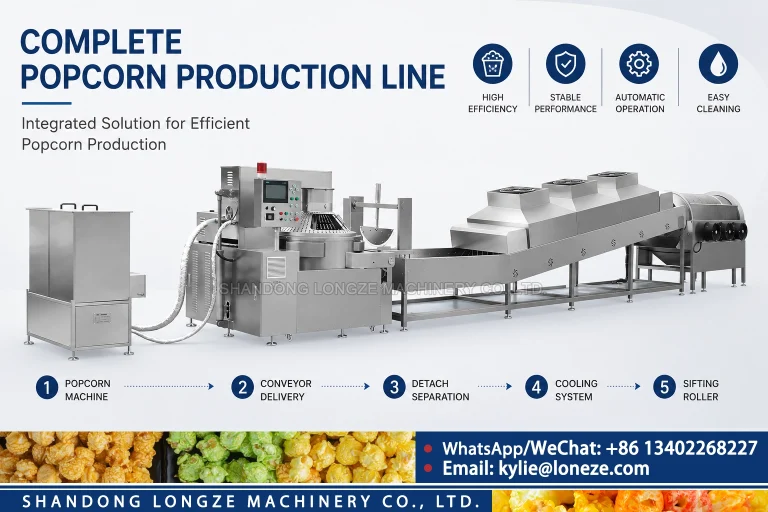
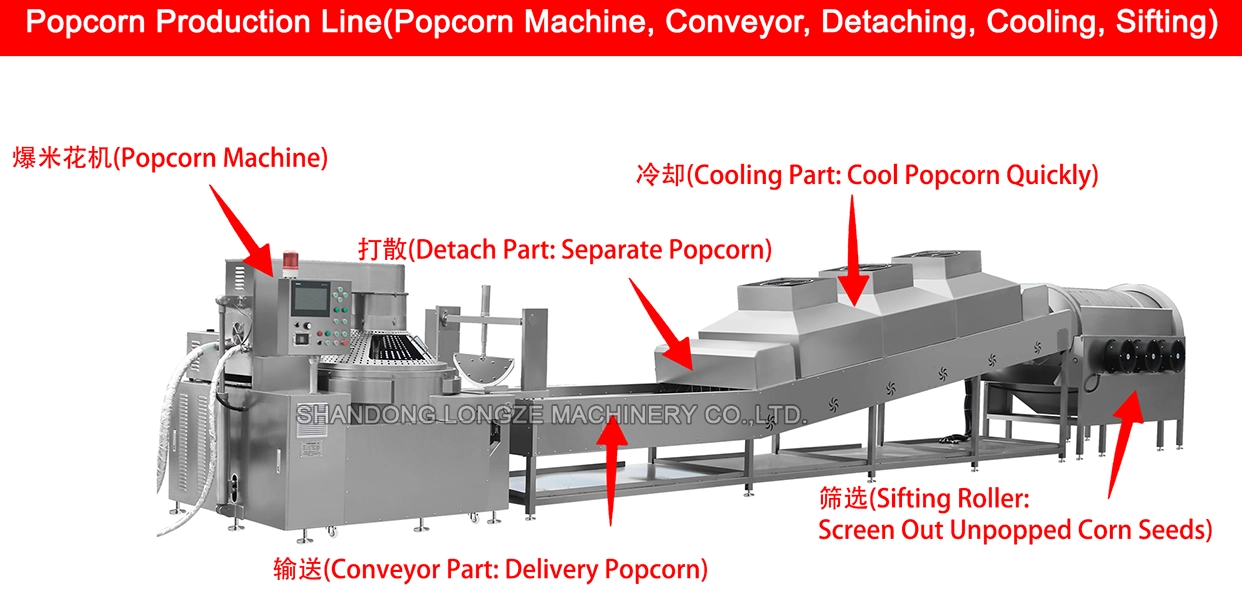
A conventional popcorn production line consists of five main sections:
Popcorn Machine → Conveyor → Popcorn Detaching Device → Cooling Fan → Sifting Drum
The operator manually operates the popcorn machine and adds the required raw materials into the cooking pot according to the production recipe.
Depending on the popcorn product, the raw materials may include:
- Popcorn kernels
- Cooking oil
- Sugar
- Glucose syrup
- Flavoring ingredients
- Other recipe-specific ingredients
After the popcorn is produced, it is discharged from the popcorn machine and transferred by the conveyor to the popcorn detaching device.
The detaching device helps break apart popcorn clusters before the product enters the cooling section. The cooling fan then reduces the product temperature, while the sifting drum helps separate and screen the popcorn according to the production requirements.
This configuration allows manufacturers to increase production efficiency while maintaining manual control over the popcorn-making process and recipes.
Unmanned Automatic Popcorn Production Line
For manufacturers looking for a higher level of automation, Longze also offers an unmanned automatic popcorn production line.
The basic process is:
Automatic Feeding System → Popcorn Machine → Conveyor → Popcorn Detaching Device → Cooling Fan → Sifting Drum
The key difference is the addition of an automatic feeding system before the popcorn machine.
Instead of requiring an operator to manually add the different raw materials into the popcorn machine for each production cycle, the automatic feeding system supplies the required ingredients according to the configured production process.
After the ingredients are automatically fed into the popcorn machine, the production process continues through the conveyor, detaching device, cooling fan, and sifting drum.
This allows the production line to operate with a higher level of automation and reduces manual intervention during the production process.
Standard vs Unmanned Automatic Popcorn Production Line
| Feature | Standard Popcorn Production Line | Unmanned Automatic Popcorn Production Line |
| Ingredient feeding | Manual | Automatic |
| Popcorn mahine operation | Operator required | Automatic |
| Conveyor | Included | Included |
| Popcorn detaching device | Included | Included |
| Cooling fan | Included | Included |
| Sifting drum | Included | Included |
| Automation level | Operator-assisted | High automation |
| Manual intervention | Higher | Lower |
| Suitable for | Commercial and medium-scale production | Higher-volume and automated production |
The choice between these two configurations depends on production capacity, labor availability, desired automation level, factory layout, and future investment plans.
For businesses starting commercial popcorn production, a standard popcorn production line can provide an efficient solution while retaining manual control over recipes and production.
For larger popcorn manufacturers that want to reduce manual ingredient handling and increase production automation, an unmanned automatic popcorn production line can provide a more automated solution.
Crucially, Longze’s equipment enables customers to scale up operations in line with growing production demands.
Customers can start with a single industrial popcorn machine and expand their production line as their scale of operations increases.
This approach allows equipment configurations to evolve alongside the business, eliminating the need for an upfront investment in a complete automated production line.
Need help choosing the right popcorn machine or planning a future production line?
Send us your target production capacity, popcorn products, available heating energy, factory space, and desired automation level.
Longze Machinery can help you evaluate the suitable heating method, popcorn machine capacity, and production line configuration for your application.