Introduction
Are you scaling up your food production for a busy restaurant, hotel kitchen, or food factory? Finding the right industrial cooking mixer can be challenging, especially when you need to choose from different heating methods and stirring systems. As a manufacturer with 14 years of experience at Shandong Longze Machinery, we understand that your choice depends on your specific product, volume, and kitchen setup.
Here, we answer the top 5 complex questions about industrial cooking mixers, incorporating the real specifications—like our four heating options and two advanced stirring systems—to help you make an informed decision for your business.
1. Planetary or Multi-Scraper Stirring: Which Is Right for My Product?
This is the most common dilemma. Both systems are excellent for producing sauces and fillings, but their specific actions make each one ideal for different product textures and requirements.
The Unanswered Question: “I make various products: chunky pasta sauce, smooth bean paste filling, and stir-fried tofu with vegetables. Which mixer can handle all of them?”
Professional Insight: Understanding the fundamental action of each agitator will guide you to the right choice.
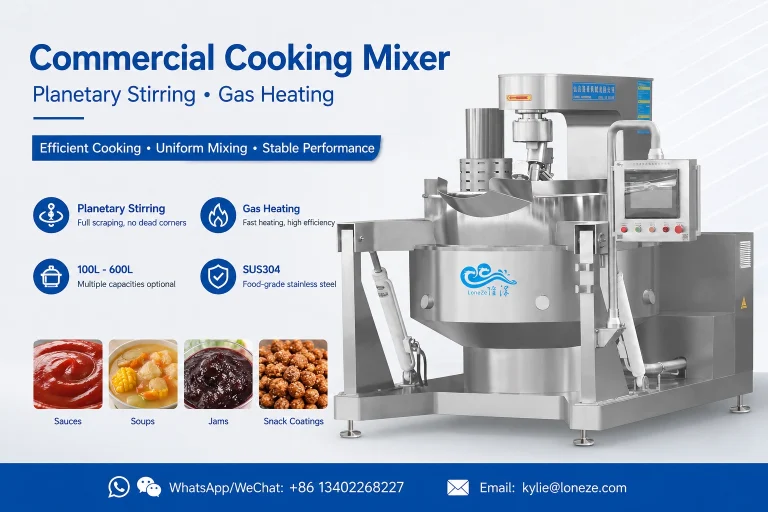
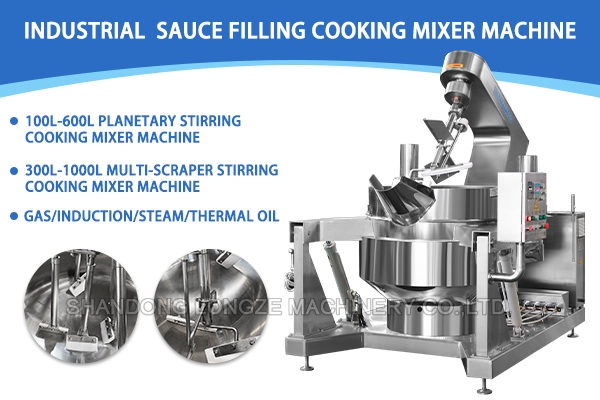
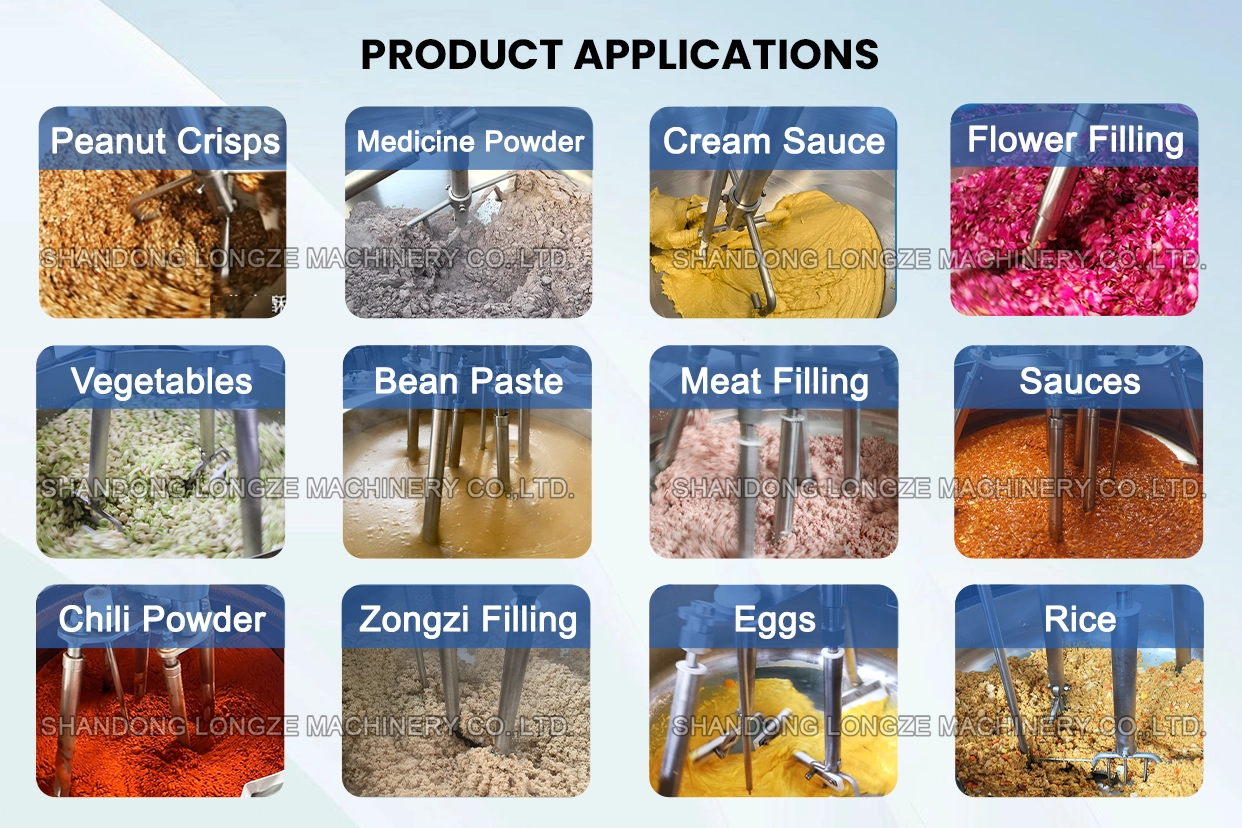
*Planetary Stirring (100L to 600L): Our planetary mixers feature an agitator that rotates on its own axis while also revolving around the kettle. This creates a comprehensive, gentle, and fold-like mixing motion. It is excellent for a wide range of sauces and fillings, from chunky tomato sauce to smooth custard fillings, as it thoroughly combines ingredients while preserving the integrity of solid pieces (like vegetable chunks or meat particles). For smaller volumes, we offer 50L capacity options in both electric induction and gas heating models—perfect for restaurants and smaller shops producing signature sauces and fillings.
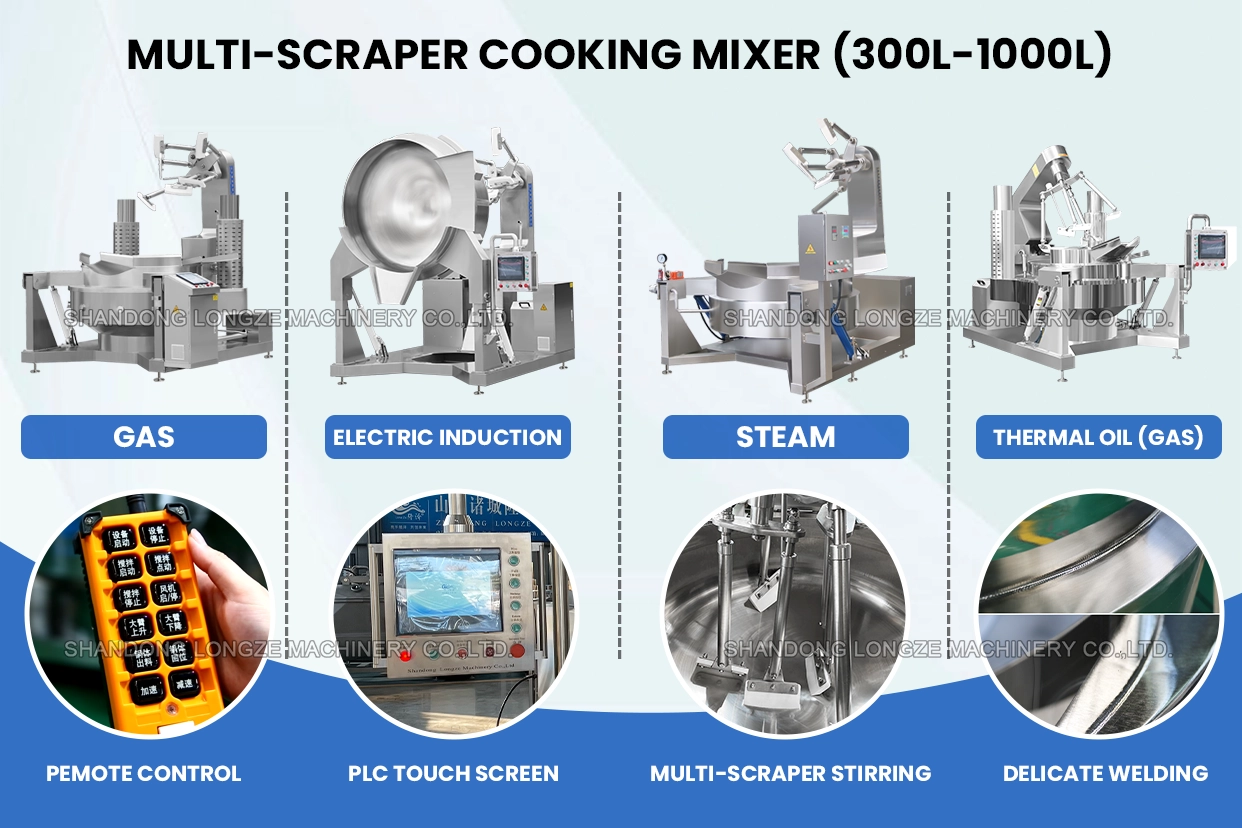
*Multi-Scraper Stirring (300L to 1000L): This system, utilizing up to 6 scrapers, is designed for products requiring intensive mixing, homogenization, or breakdown of ingredients. It is also ideal for many types of sauces and fillings, particularly those that are high-viscosity or require a very smooth, uniform texture (such as fine bean paste, nut butters, or processed cheese sauces). However, its powerful mixing action includes a breaking or mashing function. Therefore, it is not suitable for products where you need to preserve the original shape of solid ingredients (e.g., stir-frying whole tofu cubes or mixed vegetables, which would be broken down). This larger capacity range (300L-1000L) is ideal for food factories and large-scale central kitchens producing pastes, homogenized fillings, and high-volume sauces.
| Feature | Planetary Stirring Mixer | Multi-Scraper Mixer |
| Capacity | 100L-600L | 300L-1000L |
| Heating Types | Gas, Electric Induction, Steam, Thermal Oil | Gas, Electric Induction, Steam, Thermal Oil |
| Power | 20-80kw | 20-80kw |
| Agitation | Planetary stirring | Multi-scraper stirring |
| Temp Range | 40°C-260°C (customizable) | |
2. How Do I Choose Between Gas, Electric Induction, Steam, and Thermal Oil Heating?
Each heating method has distinct advantages. Your choice impacts energy costs, heating speed, and your facility’s requirements.
The Unanswered Question: “My restaurant has natural gas, but I’m worried about open flames. I’ve heard induction is faster, but is it suitable for large volumes? And what exactly is thermal oil heating for? Also, if I choose gas, are all gas burners the same?”
Professional Insight: Here’s a clear breakdown of each heating technology, with special attention to the significant differences in gas burner designs:
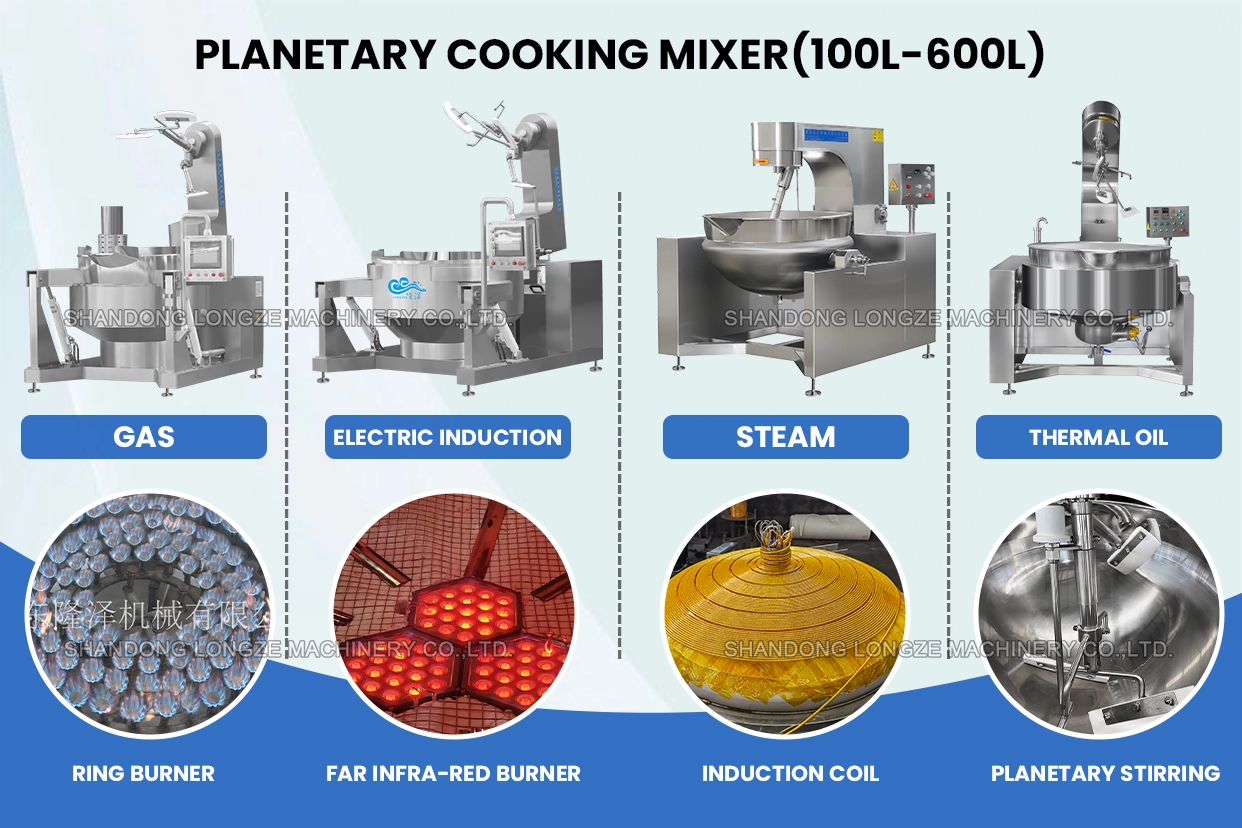
*Electric Induction Heating – The Most Advanced Choice: This is the most sophisticated heating method available today. Using electromagnetic induction, it heats the inner pot directly, eliminating any heat transfer medium or energy loss. The response is instantaneous—heat starts and stops immediately when you adjust the controls, giving you unprecedented precision. With 8 adjustable power gears, you can fine-tune the heating intensity to match your exact cooking requirements. The result is extremely fast heating, exceptionally high thermal efficiency (saving energy costs), and intelligent, programmable operation. It’s the perfect choice for modern kitchens that demand cleanliness, safety (no open flames), and precise temperature control. We offer induction heating across all capacities, including the entry-level 50L models for small businesses.
*Gas Heating – Two Distinct Technologies: Not all gas heating systems are created equal. We offer two options, each suited to different operational needs:
Natural Draft Open-Flame Multi-Ring Burner: This traditional design features multiple flame rings powered by natural draft combustion. It provides robust, direct heat and is a reliable, cost-effective choice for general cooking applications where open-flame heating is acceptable.
Infrared Forced-Air Combustion Burner (Patented Advantage): This represents the cutting edge of gas heating technology. It utilizes our patented pre-mix technology, where gas and air are perfectly blended before entering the burner chamber. This ensures complete and efficient combustion, resulting in several key advantages:
Flame-less Radiant Heating: Instead of open flames, the burner generates powerful infrared radiant heat, providing more even heat distribution and eliminating hot spots.
Sealed Combustion Chamber: The burner features a sealed furnace design with a single-needle ignition probe. The sealed chamber prevents the entry of residual gas, moisture, or dust, enhancing both safety and efficiency.
Integrated Safety Vents: In compliance with national safety standards, the furnace is equipped with strategically placed explosion-proof vents around the chamber. These vents safely relieve any pressure in the unlikely event of gas accumulation, providing critical protection against combustion risks.
10-Level Digital Power Adjustment: Firepower can be precisely regulated across 10 digital settings, giving you fine-tuned control over cooking intensity—from a gentle simmer to intense high-heat searing.
This advanced system is ideal for operations seeking the power of gas with the safety, efficiency, and precision of modern combustion technology.
*Steam Heating: The workhorse of large food factories. If your facility has a central boiler, steam-jacketed kettles provide the most powerful, uniform, and cost-effective heating for huge batches (600L-1000L).
*Thermal Oil Heating: For applications requiring very high, stable temperatures, thermal oil is the solution. Oil is heated in a closed loop and circulates through the jacket, providing even, intense heat without the pressure of steam. This is ideal for specialized industrial frying or candy production.
3. Can I Get Consistent Results Batch After Batch with Different Operators?
Consistency is crucial for your brand reputation, especially when production scales up.
The Unanswered Question: “I have multiple shifts. How can the machine help me eliminate human error and ensure every batch of sauce tastes exactly the same?”
Professional Insight: This is where control systems become essential. Regardless of whether you choose a planetary or multi-scraper model, our mixers can be integrated with programmable logic controllers (PLCs). Operators simply select a pre-set recipe, and the system automatically controls the heating intensity, stirring speed, and cooking time. This ensures your signature product tastes the same every time, from your smallest gas-heated 50L mixer to your largest steam-heated 1000L production line. With our advanced infrared gas burner, the 10-level digital adjustment allows for precise, repeatable heat profiles that can be programmed into your recipes. With electric induction models, the intelligent control system can leverage the 8 heating gears and instant response to follow complex heating profiles with precision that other methods cannot match.
4. What Maintenance Should I Plan for with These Different Systems?
Understanding long-term maintenance helps you budget and avoid downtime.
The Unanswered Question: “What parts wear out fastest in a planetary vs. a multi-scraper mixer? And does the heating type affect maintenance?”
Professional Insight:
Stirring System: In multi-scraper mixers, the Teflon or polymer scrapers (up to 6 of them) are the primary wear item. They should be inspected regularly and replaced easily when hardened. Planetary mixers have more complex gear systems that require periodic lubrication and inspection, but they have fewer direct contact wear points.
Heating System: Electric induction systems have a significant maintenance advantage—the induction coils are sealed and require virtually no maintenance over the life of the machine. For gas systems, maintenance varies by type. Standard open-flame burners may need occasional cleaning of nozzles and burner ports. Our advanced infrared forced-air burner, with its sealed combustion chamber and pre-mix technology, is designed for cleaner, more complete combustion, which typically reduces carbon buildup and extends component life. Steam systems rely on external boiler maintenance and have seals that can eventually need replacement. Thermal oil systems require periodic oil quality checks. A quality manufacturer designs all components for easy access and service.
5. How Is the Mixer Designed for Food Safety Beyond Just “Stainless Steel”?
For businesses serving the public, from restaurants to factories, hygiene is non-negotiable.
The Unanswered Question: “I know it’s stainless steel, but are there hidden seams where bacteria can grow? How do I really clean it thoroughly?”
Professional Insight: True food safety lies in hygienic design. You must inspect the craftsmanship. Our mixers feature fully welded, ground, and polished seams with smooth radius corners—no crevices for bacteria to hide. The agitator assembly (planetary head or multi-scraper frame) is designed for easy lift-out and cleaning, allowing your staff to thoroughly sanitize all food contact surfaces.